Why Job Seekers Deserve to Know What Their CV Is Really Saying
Every day, job seekers across the UAE and the wider Middle East spend hours searching for vacancies, tailoring applications and visiting offices to submit their CVs.
For some, the cost is more than time. They pay for transport, printing, document preparation and CV-writing services. They travel from one company to another, wait at reception desks and leave copies of their CV wherever they can. Many apply to hundreds of roles online as well.
Then they wait.
Many receive no response. Some receive an automated rejection. Very few are told what may actually be preventing their CV from progressing.
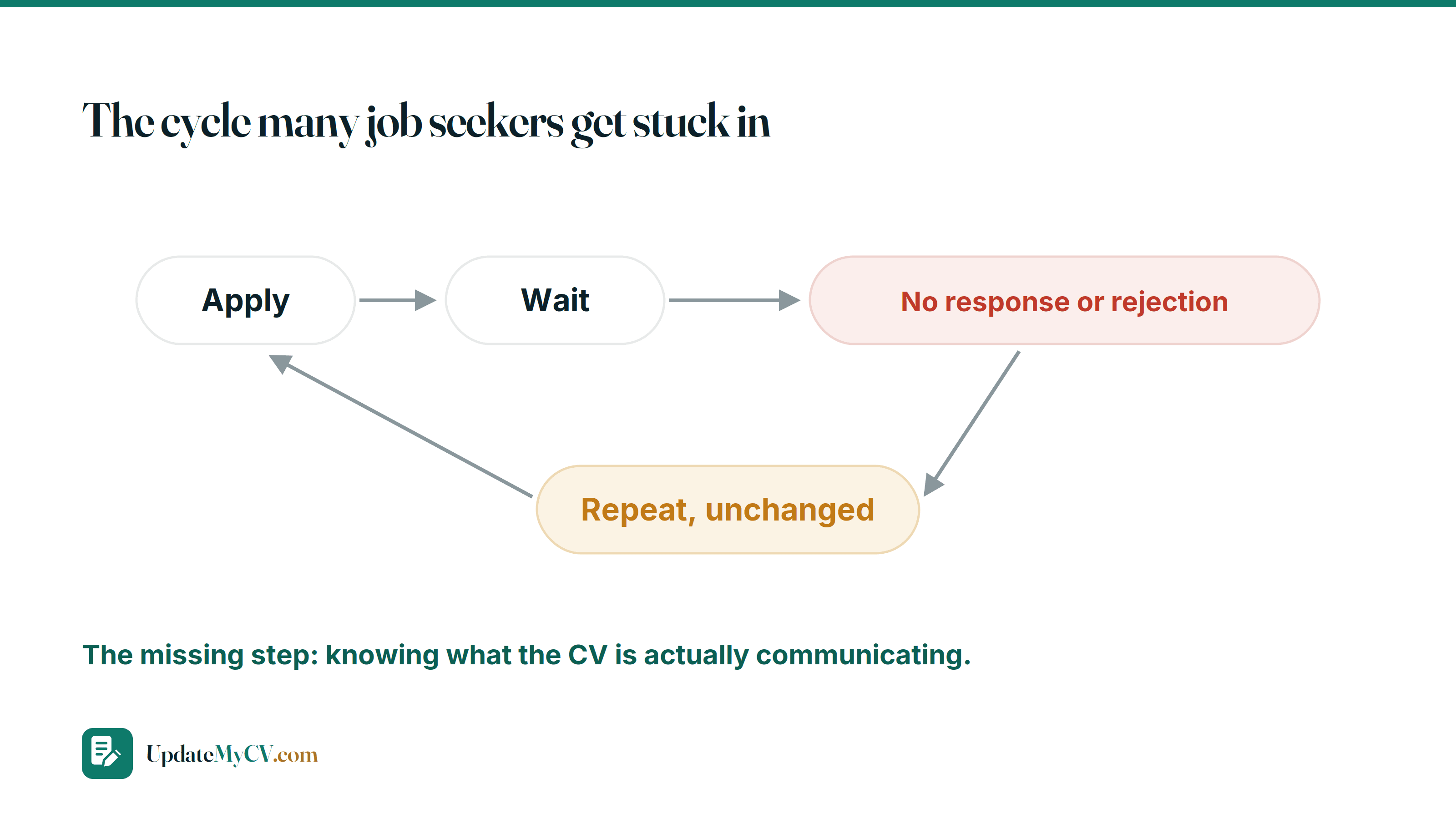
This lack of feedback creates a damaging cycle: apply, wait, get rejected and repeat, using the same CV with the same unresolved problems.
Why recruiters rarely provide detailed feedback
This is usually not because recruiters do not care.
A recruiter may receive hundreds of applications for a single vacancy. Their immediate responsibility is to identify the candidates who most closely match the requirement, not to provide an individual CV consultation to every applicant. Time, application volume, internal policies and legal considerations can all limit the feedback they can give.
As a result, candidates are left with unanswered questions:
- Is my CV easy to understand?
- Does it demonstrate the level of experience I claim?
- Are my achievements supported by evidence?
- Are employment gaps creating concern?
- Is important information missing?
- Does my CV match the role I am applying for?
- What might a UAE or Gulf recruiter notice in the first screening?
Without answers, many candidates assume the market is the only problem. Sometimes it is. But sometimes the candidate has relevant experience and the CV simply does not communicate it effectively.
What a structured CV assessment changes
UpdateMyCV was built to give job seekers the clarity they normally do not receive after applying.
Built on 16+ years of real-world recruitment experience, it examines a CV through the combined lens of recruitment screening and CV readability. The candidate receives a structured assessment explaining what is working, what may be holding the CV back and what should be improved first.
The core CV assessment is free.
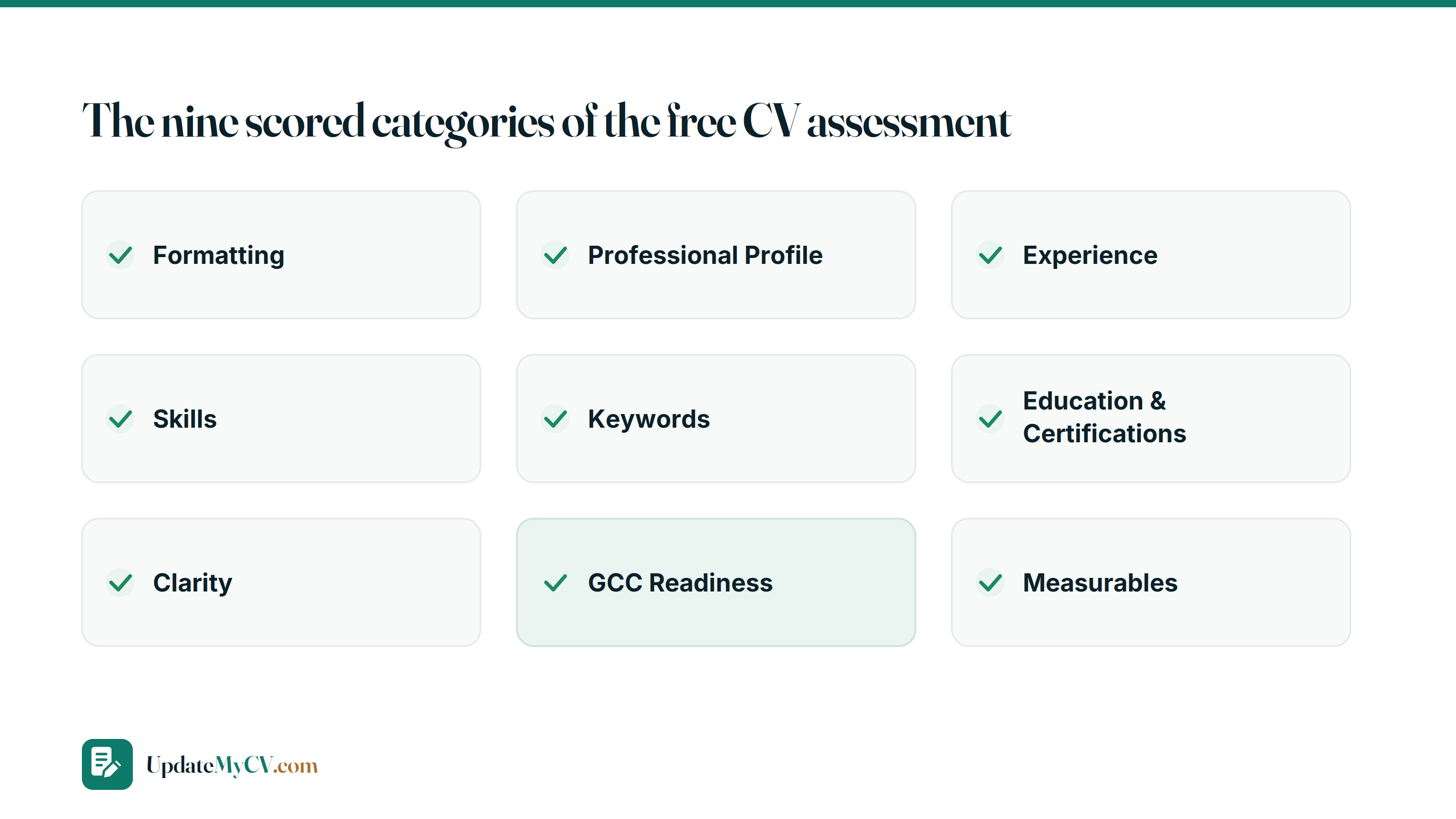
It is not merely a number at the top of a page. It scores the CV across nine categories:
- Formatting
- Professional Profile
- Experience
- Skills
- Keywords
- Education & Certifications
- Clarity
- GCC Readiness
- Measurables
Alongside the nine scored categories, the assessment also highlights questions a recruiter may ask after reading the CV, so candidates can prepare answers before screening rather than being caught off guard.
It explains why, not just what
Generic advice tells candidates to "improve the CV", "add keywords" or "make it ATS-friendly". That is rarely enough to produce a meaningful improvement.
A useful assessment identifies the actual issue and explains its significance.
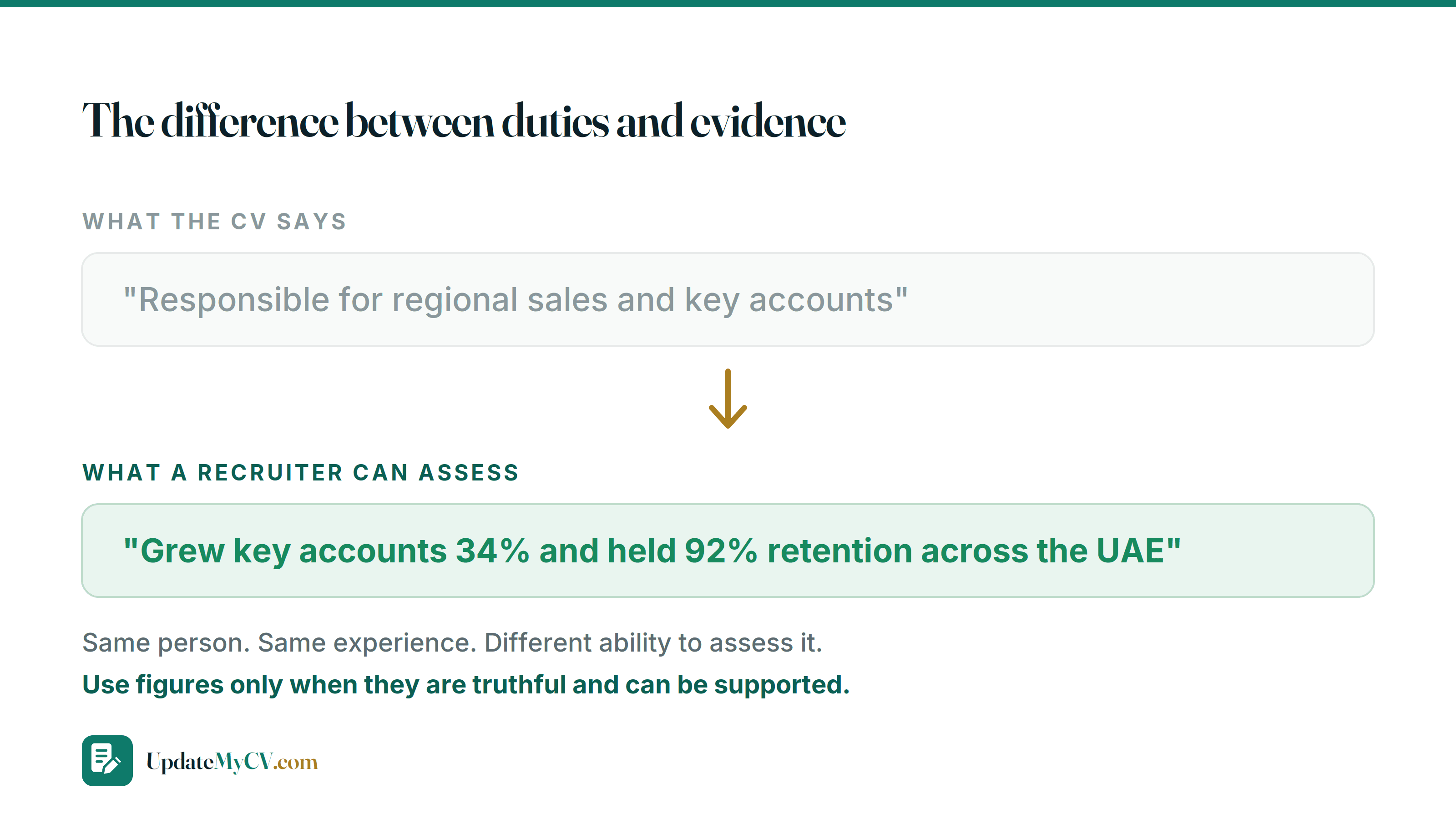
For example, a sales professional may describe responsibilities clearly but provide no quota achievement, pipeline value, conversion rate or deal information. The problem is not necessarily a lack of experience. The problem is that the CV gives the recruiter too little evidence to assess performance.
A candidate may state that they live in Dubai while showing an employment history entirely outside the UAE. That can create practical questions about current location, work status and availability. Clarifying those points can make the CV easier to process.
Another candidate may have a strong career history but unexplained timeline gaps. A short, truthful explanation may prevent the recruiter from being left to make assumptions.
This is the clarity an assessment should provide: not cosmetic criticism, but an explanation of how information may be interpreted during screening.
It helps candidates prioritise the right improvements
Candidates are often overwhelmed by conflicting CV advice. One person tells them to add a photograph. Another tells them to remove it. One asks for more detail. Another says the CV must fit on one page.
A structured assessment helps separate material issues from personal preferences.
Instead of rewriting everything blindly, candidates can focus on the changes likely to matter most, such as:
- Supporting achievements with credible figures.
- Clarifying employment dates and unexplained gaps.
- Making relevant skills easier to find.
- Strengthening the professional profile.
- Adding practical hiring information where appropriate.
- Ensuring that qualifications and certifications are clear.
- Preparing answers for questions the CV is likely to raise.
Personal and sensitive information should always be handled thoughtfully. Details such as nationality, date of birth, marital status or a photograph are not universal CV requirements and should not determine a candidate's professional value.
The impact on a job seeker
A CV assessment cannot guarantee an interview or a job. Hiring decisions depend on the vacancy, competition, experience, compensation, availability and many other factors.
What it can do is reduce avoidable uncertainty.
It can help candidates:
- Present genuine experience more clearly.
- Identify unsupported claims before a recruiter does.
- Prepare for likely screening questions.
- Apply more selectively and with greater confidence.
- Avoid repeating the same mistakes across applications.
For someone travelling from office to office, every unnecessary journey has a cost. Transport, printing and lost working hours add up. The emotional cost of repeated rejection without explanation can be even greater.
The free assessment is where this starts. For candidates who want to go further, Job Match compares a CV against a specific vacancy, and CV optimisation is a separate step that helps present existing experience more effectively. Each does a different job, and none of them invents experience a candidate does not have.
Giving candidates meaningful feedback before they apply will not remove every barrier in the job market. But it can help ensure that their CV is not one of the barriers they could have fixed.
Recruitment insight should not be available only to a few
Professional CV consultations can be useful, but they are not affordable or accessible to everyone. Every job seeker should have access to basic clarity about how their CV may be interpreted, regardless of whether they can afford professional CV support.
That is why the core UpdateMyCV assessment, built on 16+ years of real-world recruitment experience, is free.
The purpose is simple: to give candidates access to the recruitment perspective they rarely receive, help them understand their CV before submitting it and enable them to make more informed decisions about their job search.
Before spending another day applying everywhere, start by understanding what your CV is communicating.
Know your CV before they do.