How the UpdateMyCV Score Works
Published 20 September 2026Last updated 20 September 2026
The UpdateMyCV score is an assessment of how your CV is likely to be interpreted during recruitment screening. It examines your CV across nine scored categories, from formatting to GCC readiness, and explains what is working, what may be holding your CV back and what to improve first. It is built on 16+ years of real-world recruitment experience, and the core CV assessment is free.
This page explains exactly what the score measures, what it deliberately does not claim, and how to use it.
What does the score measure?
The score looks at your CV the way it is actually read during screening: quickly, practically and with specific questions in mind. Can this document be parsed and scanned without friction? Does it show who you are and what you have done? Does it give a recruiter evidence to assess, or only duties to take on trust? Does it answer the practical questions a Gulf-market screening raises?
Each of the nine categories below is scored individually. They do not all carry the same weight, and together they inform your overall score. The value is not the number itself. The value is knowing why each category scored the way it did, and which fixes matter first.
What is the score not?
Honesty about limits is part of the method, so four boundaries are stated plainly.
1. It is not an ATS. UpdateMyCV is not an applicant tracking system, does not sit inside any employer's hiring process and does not decide any application.
2. It is not a universal number. Employers and systems weigh things differently, so no single score exists across all of them. This score reflects how well your CV is likely to perform against the screening logic and reading habits they broadly share.
3. It is not a guarantee. A score cannot promise an interview, a shortlist or a job. Hiring outcomes depend on the vacancy, competition, experience, compensation, availability and many other factors beyond any document.
4. It is not a judgement of you. A low score may mean the CV is not presenting the candidate's experience clearly or effectively. It assesses the document, not the person.
What are the nine scored categories?
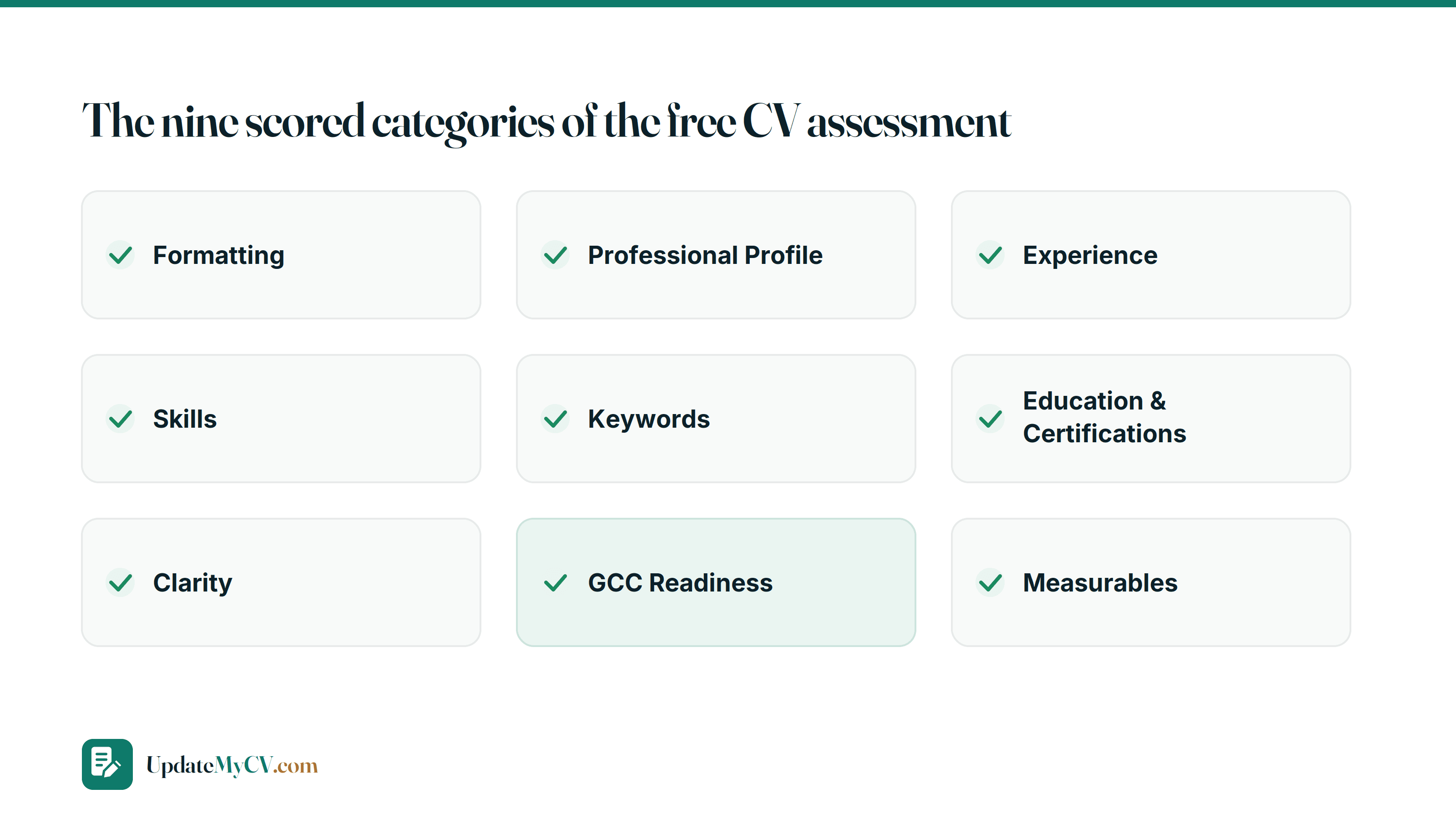
1. Formatting. Whether your CV's structure survives machine parsing and a recruiter's 30-second scan. Standard section headings, a clean single-column layout and consistent date formats score well. Tables, graphics and text boxes that may scramble when systems read the file score poorly. Strong means nothing about the layout gets in the way of the content.
2. Professional Profile. Your opening summary. In roughly three to four lines it should establish who you are, your seniority, your market and sector, and your strongest genuine result. The common failure is a template opening such as "results-driven professional seeking a challenging opportunity", which gives a recruiter nothing to work with.
3. Experience. The quality and presentation of your work history: clear progression, sensible role scope, relevance to the roles you are targeting and the right balance of detail. Recent roles should carry the weight, older roles can be compressed, and bullets should show what changed because of you rather than merely listing duties.
4. Skills. Whether your listed skills are relevant, specific and credible: named tools, systems and competencies that match your actual work, organised so they can be found in seconds. A long list of vague soft skills that nobody can verify weakens rather than strengthens this category.
5. Keywords. Whether your CV carries the terms recruiters actually search for in your profession, including role-specific language, systems and methodologies. Many roles are filled through database searches, so missing terminology can make you harder to find. Only keywords that truthfully reflect your experience belong on your CV.
6. Education & Certifications. Whether your qualifications are stated without ambiguity: highest qualification, institution, completion dates, and the licences and certifications that matter for your field. A recruiter should never have to guess what you hold.
7. Clarity. How easily a reader understands your CV: plain language, digestible bullets, explained abbreviations and a clear professional identity. If a recruiter finishes reading and is still unsure what you actually do, the CV lacks clarity regardless of how strong the underlying experience is.
8. GCC Readiness. The Gulf-market conventions that generic CV guidance may not account for: current location, phone number with country code, visa or work-authorisation status where relevant, notice period or availability, languages, GCC or MENA experience presented clearly, and role-specific licences or driving requirements where applicable. One boundary matters here: nationality, date of birth, marital status and photographs are not universal CV requirements, and they are never treated as measures of professional value.
9. Measurables. Whether your achievements are supported by figures a recruiter can assess: revenue, growth percentages, targets against achievement, team size, retention, budgets, volume, time, accuracy or scale. "Responsible for key accounts" gives little evidence. "Grew key accounts by 34%" gives something assessable, provided the figure is truthful and supportable. The assessment never encourages invented numbers.
What sits beyond the nine categories?
Alongside the scored categories, the assessment highlights Questions a Recruiter May Ask: the practical questions your CV is likely to raise during screening, such as an unexplained gap, a location that does not match your recent employment history, or a qualification that is unclear. This is a separate feature, not one of the nine scored categories. Its purpose is simple: you prepare your answers before screening instead of being caught off guard during it.
Why does the assessment include a GCC lens?
Because CVs are not read the same way everywhere. Recruiters screening for UAE and Gulf roles work through practical questions early: where the candidate is, whether they can work, when they can start, and what regional experience they bring. A CV that answers these cleanly is simply easier to process. Generic CV guidance may not account for these regional conventions, which is why GCC Readiness is scored as its own category rather than treated as an afterthought.
The truthfulness principle
Nothing in the assessment rewards invention. The score measures how well your CV presents the experience you genuinely have. Where the assessment suggests keywords, it means terms you can truthfully claim. Where it points to missing evidence, it means figures you can actually support. CV optimisation, a separate step, helps present existing experience more effectively. It never adds qualifications, achievements or experience you do not have, because unsupported claims can create serious credibility problems during screening or interview.
How should you use your score?
Priorities over perfection. The assessment tells you what is holding your CV back most, so fix the priority findings first rather than rewriting everything at once. Re-check after you make changes. And when you are targeting one specific vacancy, use Job Match, a separate journey that compares your CV against that job description rather than assessing the CV on its own.
Related reading
Why Job Seekers Deserve to Know What Their CV Is Really Saying explains the feedback gap this assessment exists to close.
Know your CV before they do.